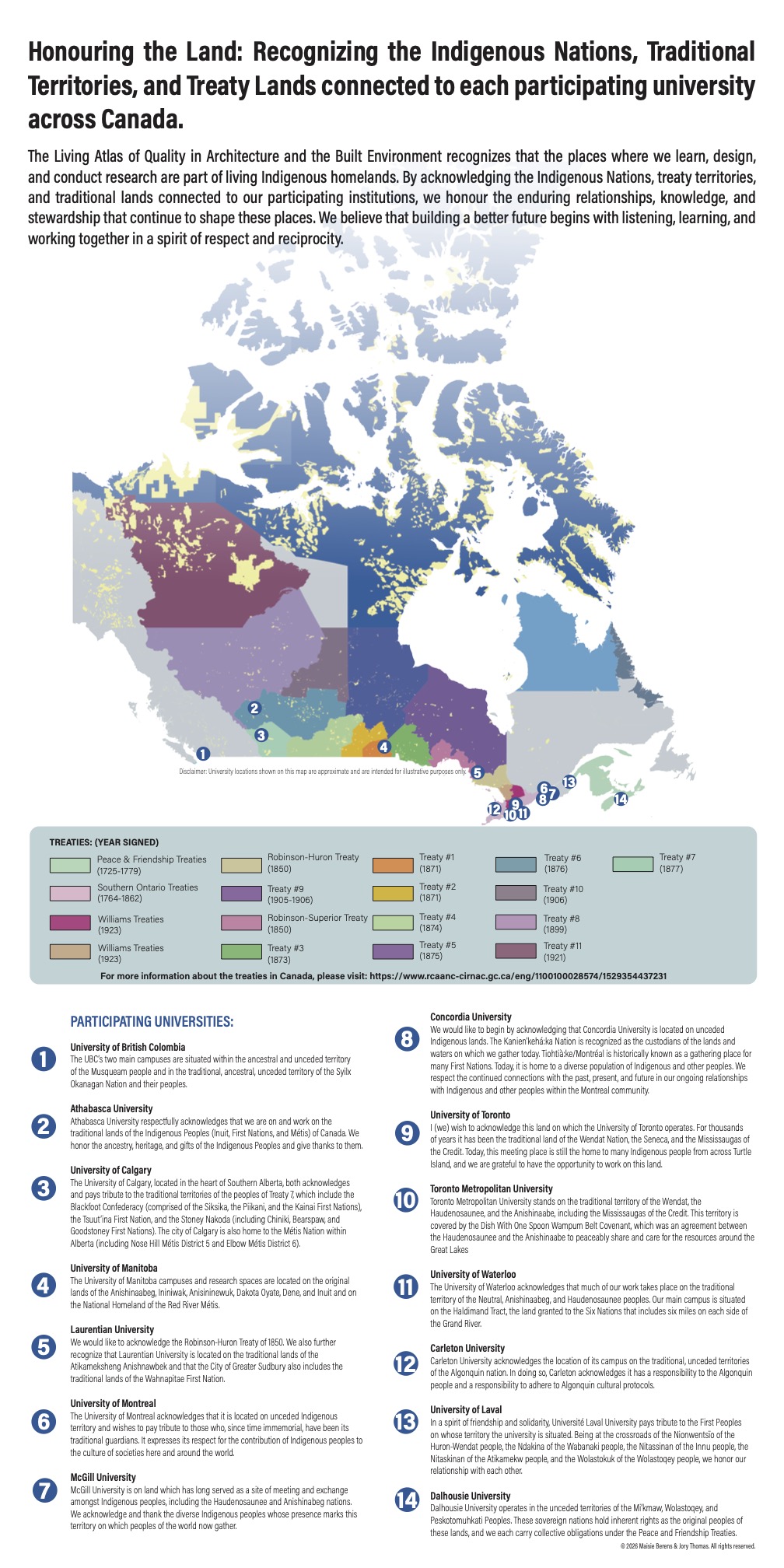
This post presents a visual mapping of Indigenous territories and treaties acknowledged by all partners of the SSHRC Partnership on Quality. This new Land Acknowledgement Map was created by Indigenous students Maisie Berens and Jory Thomas from the University of Manitoba following an initiative imagined by Indigenous student Trishtina Godoy-Contois and the project director, Prof. Jean-Pierre Chupin.
This resource highlights the Indigenous Nations, traditional territories, and treaty lands connected to each university participating in the SSHRC Quality in the Built Environment project (QBE) across “Turtle Island”. By bringing together these acknowledgements in a single visual resource, the map invites us to better understand the Indigenous homelands on which our institutions live, learn, teach, research, and design.
The map reflects QBE’s commitment to recognizing the enduring relationships, knowledge systems, and stewardship of Indigenous Peoples. It serves as a reminder that the built environment is inseparable from the histories, cultures, and communities that have shaped these places since time immemorial. This represents another important step in the QBE project’s ongoing commitment to Indigenous engagement, building on previous collaborations, contributions, and knowledge-sharing initiatives that have helped shape the project over time.
We are grateful to Maisie Berens and Jory Thomas for their work, creativity, research, and leadership in developing this resource. Their contribution enriches the QBE project as well as the Living Atlas of Quality and supports ongoing reflection, learning, and dialogue about Indigenous presence, history, and futures within the built environment.
You can download the Land Acknowledgement Map in high resolution below.
PARTICIPATING UNIVERSITIES:
[1] University of British Colombia
The UBC’s two main campuses are situated within the ancestral and unceded territory of the Musqueam people and in the traditional, ancestral, unceded territory of the Syilx Okanagan Nation and their peoples.
[2] Athabasca University
Athabasca University respectfully acknowledges that we are on and work on the traditional lands of the Indigenous Peoples (Inuit, First Nations, and Métis) of Canada. We honor the ancestry, heritage, and gifts of the Indigenous Peoples and give thanks to them.
[3] University of Calgary
The University of Calgary, located in the heart of Southern Alberta, both acknowledges and pays tribute to the traditional territories of the peoples of Treaty 7, which include the Blackfoot Confederacy (comprised of the Siksika, the Piikani, and the Kainai First Nations), the Tsuut’ina First Nation, and the Stoney Nakoda (including Chiniki, Bearspaw, and Goodstoney First Nations). The city of Calgary is also home to the Métis Nation within Alberta (including Nose Hill Métis District 5 and Elbow Métis District 6).
[4] University of Manitoba
The University of Manitoba campuses and research spaces are located on the original lands of the Anishinaabeg, Ininiwak, Anisininewuk, Dakota Oyate, Dene, and Inuit and on the National Homeland of the Red River Métis.
[5] Laurentian University
We would like to acknowledge the Robinson-Huron Treaty of 1850. We also further recognize that Laurentian University is located on the traditional lands of the Atikameksheng Anishnawbek and that the City of Greater Sudbury also includes the traditional lands of the Wahnapitae First Nation.
[6] University of Montreal
The University of Montreal acknowledges that it is located on unceded Indigenous territory and wishes to pay tribute to those who, since time immemorial, have been its traditional guardians. It expresses its respect for the contribution of Indigenous peoples to the culture of societies here and around the world.
[7] McGill University
McGill University is on land which has long served as a site of meeting and exchange amongst Indigenous peoples, including the Haudenosaunee and Anishinabeg nations. We acknowledge and thank the diverse Indigenous peoples whose presence marks this territory on which peoples of the world now gather.
[8] Concordia University
We would like to begin by acknowledging that Concordia University is located on unceded Indigenous lands. The Kanien’kehá:ka Nation is recognized as the custodians of the lands and waters on which we gather today. Tiohtià:ke/Montréal is historically known as a gathering place for many First Nations. Today, it is home to a diverse population of Indigenous and other peoples. We respect the continued connections with the past, present, and future in our ongoing relationships with Indigenous and other peoples within the Montreal community.
[9] University of Toronto
I (we) wish to acknowledge this land on which the University of Toronto operates. For thousands of years, it has been the traditional land of the Wendat Nation, the Seneca, and the Mississaugas of the Credit. Today, this meeting place is still the home to many Indigenous people from across Turtle Island, and we are grateful to have the opportunity to work on this land.
[10] Toronto Metropolitan University
Toronto Metropolitan University stands on the traditional territory of the Wendat, the Haudenosaunee, and the Anishinaabe, including the Mississaugas of the Credit. This territory is covered by the Dish With One Spoon Wampum Belt Covenant, which was an agreement between the Haudenosaunee and the Anishinaabe to peaceably share and care for the resources around the Great Lakes
[11] University of Waterloo
The University of Waterloo acknowledges that much of our work takes place on the traditional territory of the Neutral, Anishinaabeg, and Haudenosaunee peoples. Our main campus is situated on the Haldimand Tract, the land granted to the Six Nations that includes six miles on each side of the Grand River.
[12] Carleton University
Carleton University acknowledges the location of its campus on the traditional, unceded territories of the Algonquin nation. In doing so, Carleton acknowledges it has a responsibility to the Algonquin people and a responsibility to adhere to Algonquin cultural protocols.
[13] University of Laval
In a spirit of friendship and solidarity, Université Laval University pays tribute to the First Peoples on whose territory the university is situated. Being at the crossroads of the Nionwentsïo of the Huron-Wendat people, the Ndakina of the Wabanaki people, the Nitassinan of the Innu people, the Nitaskinan of the Atikamekw people, and the Wolastokuk of the Wolastoqey people, we honor our relationship with each other.
[14] Dalhousie University
Dalhousie University operates in the unceded territories of the Mi’kmaw, Wolastoqey, and Peskotomuhkati Peoples. These sovereign nations hold inherent rights as the original peoples of these lands, and we each carry collective obligations under the Peace and Friendship Treaties.